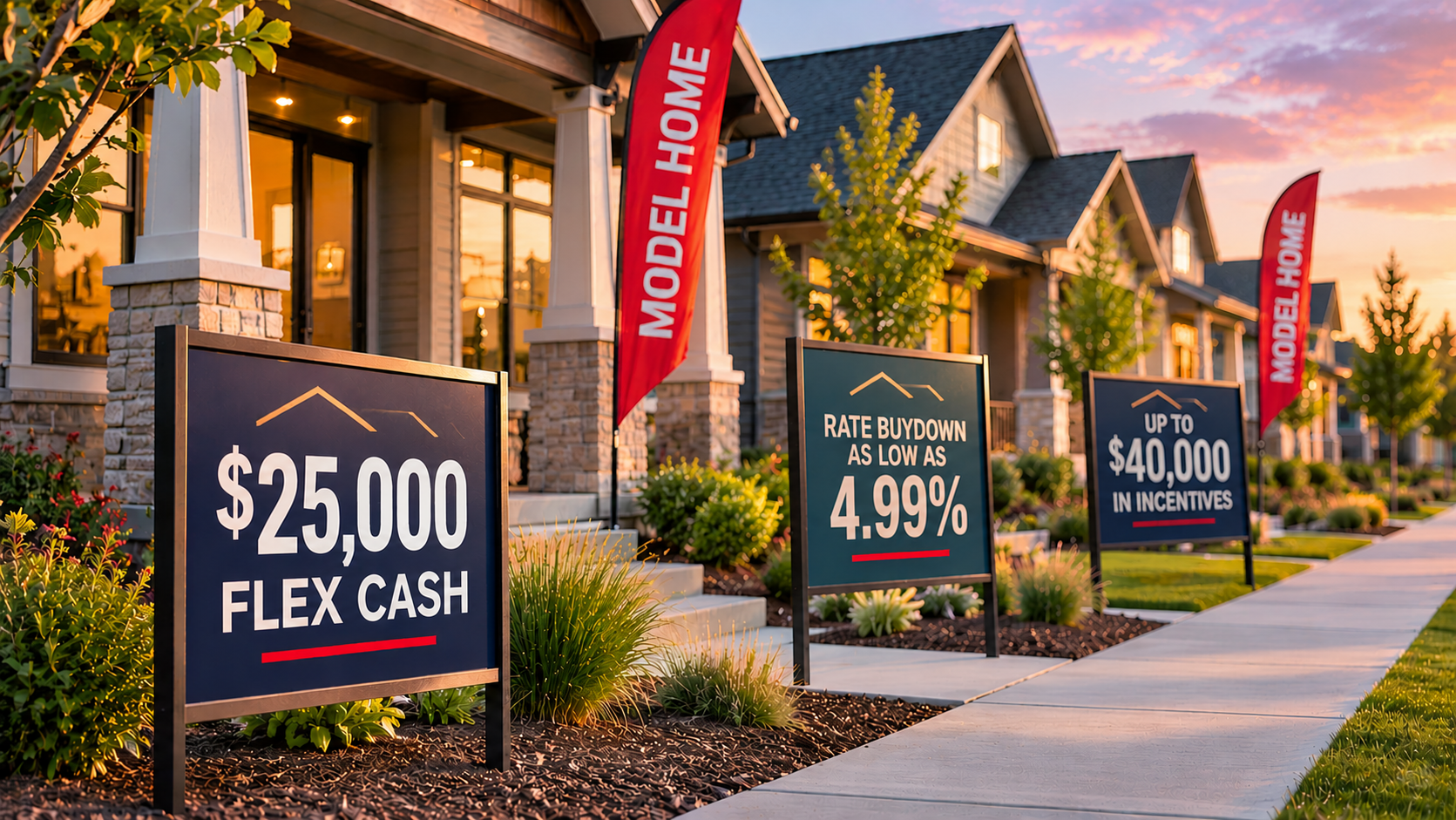
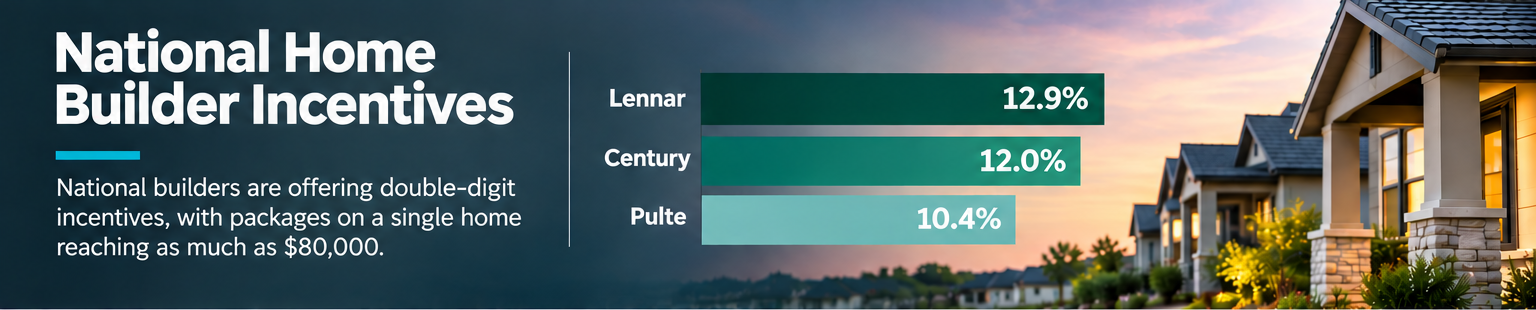
If you're a regional builder, you've probably watched this play out in your own market. A national builder down the street starts stacking incentives: rate buydowns, closing costs, design center credit. Some builders tell us they've seen packages on a single home approach $80,000.
That isn't just a promotion. It's a business model. In its Q2 2026 results, Lennar reported an average sales price of $371,000 with incentives running about 12.9%, or roughly $48,000 per home. An August 2026 Zelman & Associates analysis put incentives for Pulte at 10.4% and Century Communities at about 12%.
The nationals can absorb that because they can make it back somewhere else. According to the same Zelman analysis, they're offsetting incentives with 5% to 7% savings on construction costs. That's purchasing leverage most local and regional builders don't have.
The pressure reaches everyone. The NAHB reported that 65% of builders were using incentives in October 2026, the 19th straight month at 60% or higher. Another 43% reported cutting prices. (Source: NAHB/Wells Fargo Housing Market Index)
If you try to match the nationals dollar for dollar, you'll likely lose.
Incentives can also make lead conversions harder. A sales process that leads with discounts can leave hesitant buyers wondering whether a better deal is coming. Instead of resolving uncertainty, the offer can give them another reason to wait. That's why good sales discovery and an understanding of the buyer's genuine concerns matter so much.
Your Existing Homeowners are the Secret Weapon to Help You Sell More Homes
So what gets buyers off the fence when you can't win on incentives? One answer is the people who already bought a home from you.
A homeowner who loves their home and talks about the experience gives prospective buyers something a rate buydown can't: confidence. Most builders understand the value of referrals. But few have a reliable way to earn them and recognize where they come from.
We've written before about turning happy homeowners into advocates. That foundation still matters. But in today's market, the bigger question is whether homeowner referrals can become a meaningful alternative to discounting through incentives.
Why Most Builder Referral Programs Don't Generate Many Sales
Ask a builder whether they have a referral program and the answer is almost always yes. Ask how it works and you usually hear some version of this: we'll pay $500 if someone you refer closes. It's a line in a closing email or a welcome packet, and then nobody mentions it again.
The problem isn't necessarily the dollar figure. It’s the timing. A reward offered at closing has nothing to do with the experience that makes people want to recommend you. And because it’s treated as a one-time promotion, no one owns it and no one measures how well it works.
That distinction matters. Offering money for a referral and building a base of homeowners who willingly recommend you are two different things.
What Makes a Homeowner an Advocate?
Think about Sandra, a new home buyer who moved in last year. She's proud of her home, stays involved in the neighborhood, and has already recommended her builder to friends. When someone asks what the building process was really like, she answers from experience, including the parts that weren't perfect.
Sandra isn't a paid spokesperson. She's more valuable than that. She gives future buyers a perspective they can't get from a model-home tour or a promotional offer.
A high move-in survey score is a useful signal, but it isn't the same as advocacy. Some satisfied buyers never mention their builder again. Others keep telling the story. The opportunity is to understand what creates that difference, not simply to offer a reward at closing.
Referrals Convert Better and Cost Less
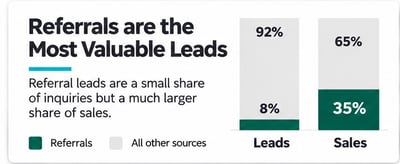
Referral leads may be a small share of inquiries but a disproportionately large share of sales. Builder Lead Converter's May 2026 analysis of more than 15,000 leads reported that referrals accounted for 8% of leads and 35% of sales. On those figures, referred leads converted at roughly six times the rate of other leads.
 Consider a hypothetical program that costs $20,000 a year to operate and produces five additional sales. That's $4,000 in program spending per incremental sale, compared with incentive packages that can run into the tens of thousands on a single home. It's not an apples-to-apples accounting comparison, but it shows why referral economics deserve attention.
The distinction goes beyond acquisition cost. Price cuts can affect comparable sales and create tension with recent buyers. Referrals offer a way to compete on trust and experience without making the next discount the centerpiece of the conversation.
You can't outspend the nationals. But you can give buyers a reason to choose you that isn't on the price sheet.
What a Referral Program Needs to Work

A successful program isn't just a list of rewards. It depends on three things: an experience homeowners want to talk about, a relationship that continues after closing, and a way to connect that advocacy to actual sales.
The first is the hardest to manufacture. Buyers remember how your team handled uncertainty, whether promises were kept, and what happened when something went wrong. Those experiences determine whether a homeowner recommends you when a friend asks.
The second requires attention after move-in. Homeowners don't stop forming opinions about their builder on closing day. The third requires accountability. If no one owns the effort and the team can't identify referral-driven sales, the program remains a nice idea instead of a measurable business initiative.
The tactical work matters, too. We've put the practical framework into a separate resource for builders who want to evaluate or launch a program, including how to identify potential advocates, build meaningful touchpoints, capture referrals in the CRM, and measure results.
Download the Home Builder Referral Program Playbook to get the step-by-step framework:
How the Warranty Experience Can Undermine Referrals
Here's the part many referral conversations miss. The homeowners who praise you at move-in are the same ones who may need warranty help a few months later.
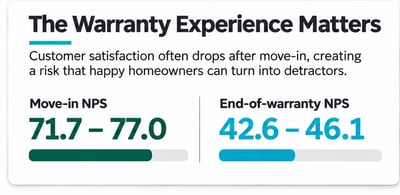 We see this even with builders who have a mature customer experience (CX) program. In 2025, one of the strongest CX programs we work with posted move-in NPS between 71.7 and 77.0. End-of-warranty NPS ran between 42.6 and 46.1, roughly 25 to 30 points lower.
Those are aggregate scores, not proof that the same homeowners changed their minds. But the gap is a warning. A homeowner like Sandra may have recommended you enthusiastically at closing. But a poorly handled warranty issue can change what she says to the next person who asks.
This is why advocacy can't belong only to marketing or sales. Warranty response, follow-through, and communication are part of the referral strategy. If the experience breaks down after move-in, a recognition program won't fix it.
A strong move-in score tells you how buyers felt at one milestone. Their experience after closing helps determine whether that goodwill lasts.
Compete on Customer Experience, Not Incentives
One regional builder we work with made a deliberate call this year. Instead of matching the incentives of builders down the road, they accepted fewer sales to protect their margins. They're putting more attention on the buyers they already have and the experiences they're delivering to current customers.
That isn't a retreat. It's a different competitive choice. Nationals can often spend more on incentives. They can't control what your homeowners say about you.
At Bokka, we believe referrals are earned long before anyone asks for one. They start with the experience you deliver through sales, construction, closing, and warranty. A thoughtful program can help that goodwill travel further, but it can't replace the work that earns it.
Take this to the next level with this free download
If you're ready to make homeowner advocacy a measurable part of your sales strategy, start with our Home Builder Referral Program Playbook. And if you'd like help connecting the customer experience to conversion, we'd be glad to talk.