



Artificial intelligence is reshaping nearly every industry, and homebuilding is no exception. While adoption is still uneven, momentum is building as more builders begin to see how AI can improve efficiency, decision-making, and the buyer experience.
Larger builders have moved first, applying AI across marketing, purchasing, research, and customer service. Smaller and mid-sized builders often hesitate, unsure where AI fits or whether it is worth the investment. That gap is growing, and it matters.
There is a simple truth behind the hype: AI will not take your job, but someone who knows how to use AI will.
AI Adoption Is Uneven Across the Industry
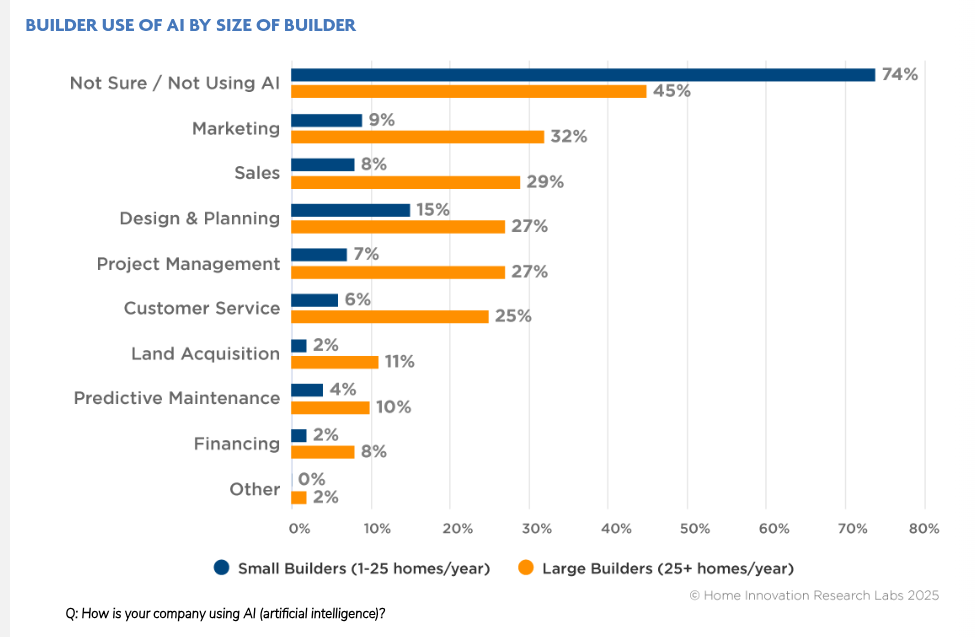
Larger builders report significantly higher AI adoption than small and mid-sized builders.
Industry data shows a clear pattern. Larger builders are experimenting with AI at higher rates, while smaller teams often cite lack of time, clarity, or internal resources as barriers.
The encouraging news is that effective AI adoption does not require a massive budget or a dedicated technology team. Many of the most impactful uses are accessible, affordable, and easy to implement when approached intentionally.
What follows are nine practical, proven ways builders are using AI today, along with one example of how not to use it.
1. Marketing and Sales
Marketing is the most common starting point for AI in homebuilding, and for good reason. According to ProBuilder, it is the area where builders see the fastest and most visible returns.
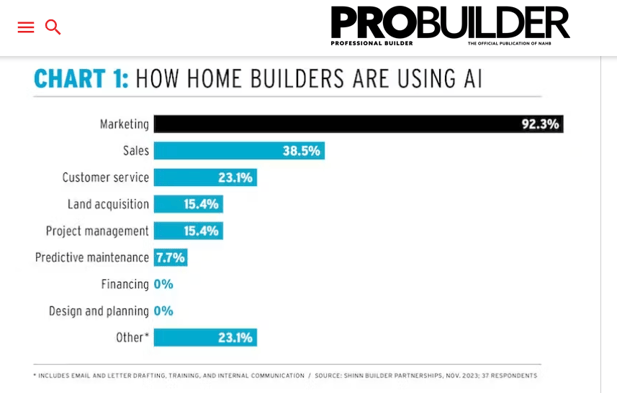
Marketing leads AI adoption, followed by sales and customer service.
AI is being used in home builder marketing to:
- Personalize website content and email campaigns based on buyer behavior
- Score and prioritize leads more accurately
- Identify patterns in marketing performance and conversion data
Tools like HubSpot’s AI features, Jasper, and ChatGPT help teams produce better content faster. HubSpot’s Breeze AI Agents, currently in beta, take this a step further by assisting with lead engagement and follow-up logic.
The result is not just faster execution, but better decision-making. Marketing teams spend less time on repetitive work and more time optimizing strategy and performance.
2. Chatbots and Answer Engines
AI-powered chatbots have become standard on builder websites. When implemented correctly, they answer common questions about pricing, availability, incentives, and warranty information while helping qualify prospects.
The next evolution is Answer Engine Optimization, or AEO. As buyers increasingly use tools like ChatGPT, Gemini, and Perplexity to get direct answers, builder websites must be structured so AI systems can accurately interpret and surface their content.
This includes clear site organization, structured data, and guidance for AI crawlers through tools like llms.txt (although the jury is still out on whether this will be a good long-term solution). But builders who prepare now will be better positioned as search behavior continues to shift.
At the same time, chatbots must be monitored closely. Incorrect or outdated responses erode trust quickly. AI should support customer interactions, not operate without accountability.
3. Prospecting
Prospecting is one of the most time-intensive parts of sales, and AI is making it more efficient.
AI-powered prospecting tools analyze CRM data, engagement history, and external signals to identify promising opportunities. They can recommend outreach strategies and predict which deals are most likely to close based on historical patterns.
The HubSpot Prospecting Agent is one example of how this technology is evolving. Used correctly, it helps sales teams focus their efforts where they are most likely to succeed.
Human oversight remains essential. AI can guide outreach, but relationships are still built person to person.
4. Content Creation
AI has quickly become a valuable assistant for content creation. Builders are using it to draft blog posts, community descriptions, listings, and advertising variations.
The speed gains are real. AI can generate multiple versions of content in minutes, making it easier to test messaging and tailor content to different audiences.
However, this is also where discipline matters most. In 2024, a real estate listing generated by AI drew attention after it included schools that did not exist. The listing had not been properly reviewed before publication, damaging credibility.
The lesson is clear. AI can draft, but people must decide. Every piece of AI-generated content should be reviewed for accuracy, tone, and local context.
5. Internal Knowledge Base
AI is also improving how builder teams access internal information.
An AI-powered internal knowledge base allows employees to ask natural language questions and receive instant answers pulled from company documents, CRMs, and internal systems.
Instead of searching folders or sending emails, teams get immediate clarity. This reduces friction, speeds onboarding, and keeps departments aligned across communities and markets.
6. Purchasing and Cost Analysis
Purchasing and cost control are becoming increasingly data-driven, and AI plays a growing role.
Builders are using AI to forecast material usage, analyze pricing trends, and compare supplier quotes. When connected to ERP and estimating systems, AI can flag potential overruns early and surface opportunities for optimization.
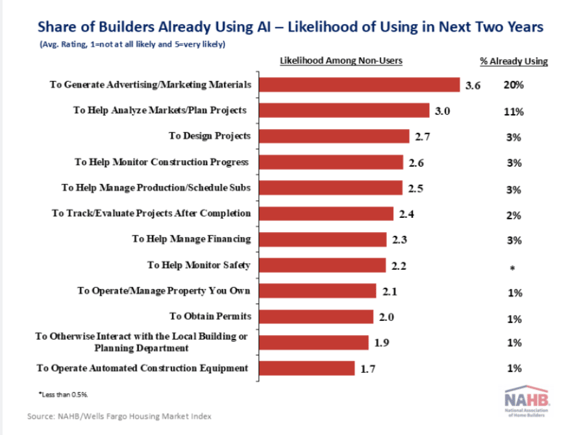
AI is increasingly applied to estimating, purchasing, and project-related decision-making.
The value is straightforward. Less waste, tighter margins, and fewer surprises during construction.
7. Personal Productivity
One of the easiest entry points into AI is personal productivity.
Tools like HubSpot Call Insights, Zoom AI Companion, and Otter.ai automatically summarize sales calls, internal meetings, and home tours. Teams spend less time taking notes and more time engaging in conversations.
The result is clearer follow-ups, better documentation, and meaningful time savings across sales and operations teams.
8. Research and Market Analysis
AI is also changing how builders analyze markets and evaluate land opportunities.
Organizations like Zonda use AI and satellite imagery to track construction activity and housing trends with greater accuracy. Builders can apply similar concepts using AI-driven tools for comparative market analysis, competitive pricing insights, and permit or zoning research.
Faster access to reliable data leads to better land decisions and reduced risk.
9. Customer Satisfaction
AI does not stop at the sale. Many builders are using it to improve the post-closing experience.
AI can analyze homeowner feedback, predict warranty needs, and automate follow-up communication. By identifying issues early, builders can respond proactively and strengthen long-term relationships.
A better homeowner experience leads directly to stronger referrals and brand reputation.
10. The Terrible Way to Use AI
The worst way to use AI is to trust it blindly.
Unchecked AI-generated content or decisions can introduce false information, damage credibility, and create compliance risks. The example of AI-generated listings with fabricated details is a reminder that speed without oversight creates real consequences.
AI should enhance expertise, not replace it. The most important rule of AI adoption is simple: keep the human in the loop.
AI adoption in homebuilding is no longer optional. It is a competitive advantage.
Larger builders may have started earlier, but smaller teams can move quickly by focusing on practical use cases like marketing, internal knowledge tools, and productivity enhancements.
The builders who succeed will not be the ones using AI everywhere, but the ones using it thoughtfully. Human expertise remains the differentiator. AI simply amplifies it.


.jpg)

