



Quantifying the Customer Experience ROI for Home Builders (2025 Update)
In 2015, we asked a straightforward question: Is it worth it for home builders to invest in the customer experience?
At the time, most builders agreed it was important, though many still treated it as a nice-to-have rather than a disciplined business strategy.
Fast forward to today, and that question is no longer optional. Customer experience is now a competitive necessity. Millennials and Gen Z buyers—who make up the majority of today’s market—expect the same level of speed, transparency, and personalization they get from online brands. They don’t just evaluate the home itself; they judge the entire journey.
The data confirms this shift. Salesforce reports that 80% of customers view the experience a company provides as equally important as the product. Independent studies on buyer behavior consistently show that reviews and word-of-mouth are decisive factors in builder selection. A single negative interaction can directly affect referrals, reputation, and revenue.
It’s one thing to put "we deliver an industry-leading experience" on your website. It’s another thing entirely to actually do it. Doing it right is a real investment. But the big question builders still have is, what's the actual, hard-dollar return on that investment?
The Real Cost of Getting the Customer Experience Wrong

Every homebuyer interacts with your team across hundreds of touchpoints—from the first website visit to the one-year warranty call. Years ago, the biggest risks were obvious issues like construction delays or unresponsive service.
Those challenges remain, but today the more subtle, recurring problems can be just as damaging.
- The Supply Chain Surprise:
A buyer spends hours in the design center selecting finishes, only to hear months later that their choice is on backorder with no clear solution. If handled poorly, this single moment can erase months of trust.The - Radio Silence:
The foundation gets poured, and your buyer is thrilled. Then silence for three weeks. To them, it feels like their home has been forgotten. A lack of proactive communication feels like a total lack of respect.The - Cookie-Cutter Approach:
When a first-time homebuyer, nervous and full of questions, gets the exact same generic email updates as a seasoned empty-nester on their fifth home. It makes the whole process feel cold and transactional, and it’s a huge missed opportunity to build a real relationship.
These issues don’t just create frustration—they create detractors. And detractors rarely leave quietly. They post negative reviews, share their story with friends and family, and influence other potential buyers to stay away.
The financial impact is significant. Consider this example: if one unhappy buyer discourages just five prospects from engaging with you, and the average profit per home is $40,000, that single negative experience can represent $200,000 in lost profit.
This is exactly why tools like Builder Signal and modern buyer portals have become so critical. They're not just fancy tech; they're essential tools for managing risk and delivering the transparency people now expect.
Key Metrics for Measuring Customer Experience in Home Building

For the longest time, the industry standard has been the post-close survey. And look, it’s a good starting point. But relying on it alone is like trying to drive a car only looking in the rearview mirror. It tells you what already happened, long after you could have done anything about it.
To truly understand performance, customer experience needs to be measured at key points throughout the journey. This is where customer satisfaction Key Performance Indicators (KPI) for builders become essential. The most effective starting point is the Net Promoter Score (NPS), a simple yet powerful tool for tracking loyalty and advocacy.
NPS is based on one central question:
“On a scale of 0–10, how likely are you to recommend us to a friend or colleague?”
Responses fall into three categories:
- Promoters (9–10): Enthusiastic buyers who drive referrals.
- Passives (7–8): Satisfied but not loyal; easily swayed by competitors.
- Detractors (0–6): Dissatisfied buyers at risk of damaging your reputation.
You get your score by subtracting the percentage of Detractors from the percentage of Promoters. But the real magic isn't the score itself—it's how you use it. Instead of just one survey at the end, imagine sending a quick NPS pulse check at key moments:
- A month after signing the contract.
- Right after the pre-drywall walk.
- The week of closing.
- 90 days after they’ve moved in.
Each survey should include the follow-up: “Why did you give that score?”
The responses reveal actionable insights—what’s working, what’s frustrating, and which changes will have the greatest impact on your overall Customer Experience (CX) ROI.
Alright, Let's Talk Money: Is It Really Worth It?
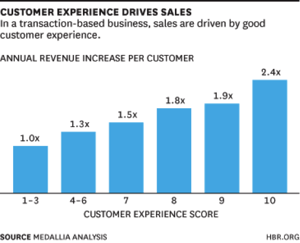 This brings us back to the big question. It takes real effort and money to overhaul processes and align your entire team around the customer. A CEO is going to look at the cost and, rightly, ask about the ROI. How many more homes are we actually going to sell?
The answer is clearer today than it was in 2015. By using home builder customer experience metrics like Net Promoter Score (NPS), it’s now possible to draw a direct line between improvements in customer satisfaction and business outcomes.
Here’s how it works: even a modest increase in NPS—say, 10 points—translates into more promoters. Promoters generate more referrals, which are among the highest-quality, lowest-cost leads a builder can get.
Add in fewer warranty issues, reduced time spent on crisis management, and fewer negative reviews, and the financial impact becomes hard to ignore.
Mini ROI Case Study
We recently worked with a regional builder whose NPS had plateaued in the mid-30s. After investing approximately $150,000 in customer journey mapping, proactive communication tools, and staff training, their NPS climbed from 35 to 50 within 18 months.
- Referral Sales Impact: That 15-point increase generated 10 additional referral sales, worth roughly $300,000 in gross profit.
- Warranty Savings: Proactive communication reduced “crisis calls” to the warranty department by a third, saving about $20,000 annually.
The result? A clear CX ROI of over 100%—more than justifying the investment.
The Market Agrees: CX Leaders Win
This isn’t just true for home building. Way back in 2015, we pointed to data from firms like Watermark Consulting and Forrester that showed a stunning trend: companies that were leaders in customer experience deliver significantly higher returns than those that lag behind.
Guess what? That trend has only gotten stronger. Year after year, the data proves that Wall Street rewards companies that treat their customers well. It’s that simple. A focus on CX isn't just a feel-good strategy; it's a core driver of financial performance.
Why This Is Your Most Important Investment for the Future
A great customer experience creates a competitive advantage that’s incredibly hard for others to copy. But looking ahead, it's even more critical. Here's why we believe this is the single best way to future-proof your business:
- You’ll Win the Next Generation: Millennials and Gen Z buyers have a sixth sense for impersonal experiences. They expect things to be easy, digital, and transparent. If you don't provide that, they will find someone who does.
- You’ll Dominate in the Age of AI: As Google and other search engines rely more on AI to summarize information, your reputation is everything. AI doesn't just read your website; it reads your reviews, your social media comments, and every bit of sentiment about your brand online. As CX expert Jay Baer puts it, “True word of mouth is more important today than ever before, because it's the one form of marketing that AI can't fake.” A history of happy customers is the best SEO money can't buy. A history of happy customers is the best SEO money can't buy.
- You’ll Be More Resilient: The market isn’t as hot as it once was, and cycles will continue to shift. During slower periods, a strong base of loyal customers and a trusted reputation provide a critical advantage. While many builders respond by cutting prices, those with high satisfaction and referral-driven pipelines are better positioned to maintain sales volume without eroding margins.
This Is What We Live and Breathe at Bokka
Our mission today is the same as it was in 2015: to help fix the new home buying experience. But how we do that has evolved dramatically. It's less about guesswork and more about data.
This is where Bokka Group comes in. We use tools like Customer Journey Mapping to give you a clear view of your entire process, highlighting where things are working well and where improvements are needed. We help you develop detailed buyer personas so communication feels personal rather than generic. Most importantly, we establish the home builder customer experience metrics that allow you to track progress and demonstrate ROI across your organization.
And the results speak for themselves.
“Bokka helped us transform our customer experience program and surpass our corporate NPS goals. Thank you for everything you do—we love our partnership with Bokka.” - Lizzie Levin, Senior VP of Sales, Marketing & CX, Holt Homes
Ready to Build Your Case for CX?
So, is it worth it to invest in the customer experience? The answer is a resounding yes. The truth is, you're already investing in it with every single customer interaction. The only question is whether you're doing it proactively and treating it like the core business discipline it is.
The builders who get this are the ones who are going to lead the industry for the next decade.
If you’re ready to move from just hoping for happy customers to building a system that reliably creates them—and proves their value—we'd love to chat. Let us help you build the business case for CX and show your team how to get it done.
.png)

